Minerva – Using technology to do primary source research
This first video describes how I used online digital archives and Google Translate to do primary source research.
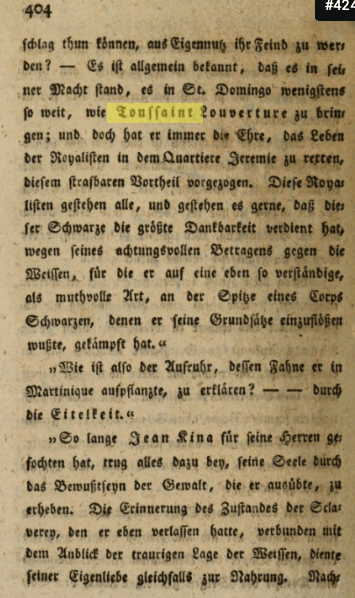
As I said in the video, the first few years of articles I investigated (I began in January 1800) were not promising for Buck-Morss’ hypothesis. The few times that “St. Domingo” did come up, it was to treat the French’s victory over the rebellious former slaves as a fait accompli, or to note how the United Kingdom, and even the United States, had imperial designs on St. Domingue. Searching for “Domingo” usually resulted in 0-2 hits. There was only one hit for “Toussaint” and zero for “Dessalines” (the first Haitian president) before 1805.
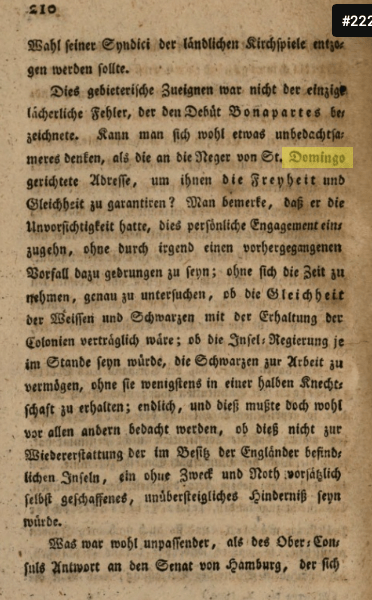
In the January – March 1800 issue, Minerva stated it was “ridiculous” and “rash” for Napoleon to promise the former slaves “freedom and equality.” In 1800, Minerva did not seem like a journal that would inspire an interest in the Haitian Revolution! In the July – September 1801 issue, an article about the Martinique rebel Jean Mira states that “he could have gone as far as Toussaint,” showing that its readers were aware, but not too interested, in the Haitian Revolution and its leader until 1802, Toussaint L’ouverture
The issues are much the same, with either limited references to events in St. Dominique, until 1805. And then, voila! Haiti suddenly becomes a major topic in Minerva: in 1805, over 10% of its pages are dedicated to events in Haiti.
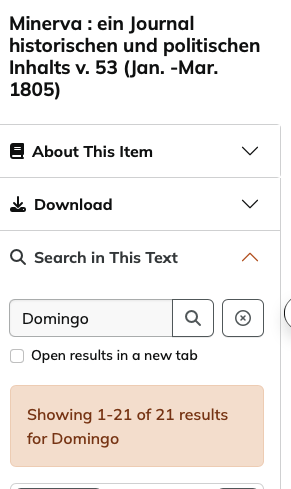
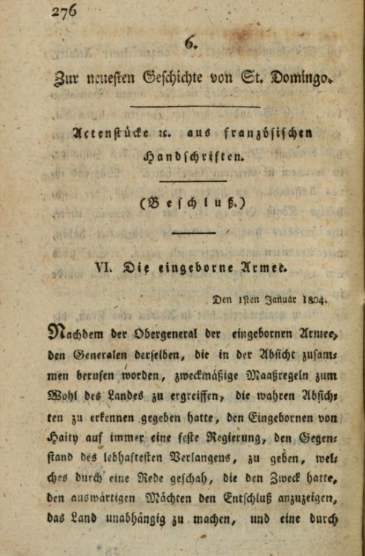
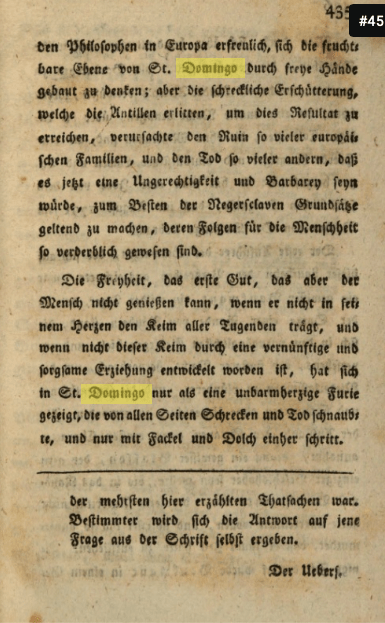
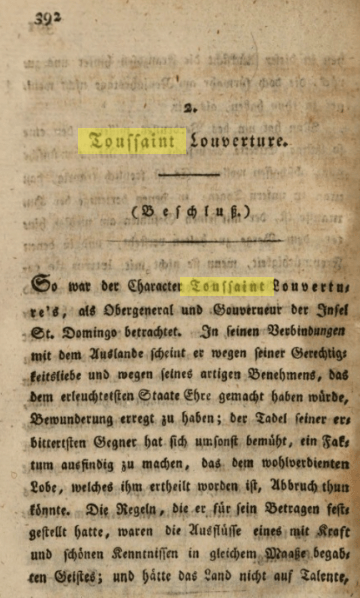
In prior issues, “Domingo” would appear 0-2 times. Compare that to the 21 times in the January – March issue!In their January – March 1805, issue Minerva published the text of Dessalines’ January 1, 1804 speech proclaiming the birth of an independent Haitian Republic, proclaiming the abolition of slavery and equality for all citizens. References to the Haitian Revolution were often highly critical, if not terribly racist. In the same issue that published Dessalines’ declaration of the Haitian Republic, another author stated that it would be “injustice and barbarity” to support the Republic won by former slaves. But later in the year, in the October – December 1805 issue, the author praised Toussaint L’ouverture’s “love of justice,” “polite character,” and leadership skills. That the Haitian Revolution could generate outright horror and enthusiastic praise surely made in interesting to Minerva’s readers, including Hegel.
 Sean Murphy - Social Studies Teacher